Speaking
Whether on stage or behind the mic, I aim to share thoughtful perspectives, practical insights, and real-world experience from my research. Selected talks and podcast appearances are featured below. Media reporting of my research can be seen here.
TALKS
BBC Wales Today - Cervical Screening. 29th June 2026
In BBC Wales Today, myself and others discussed the barriers Autistic women may face when accessing cervical screening, including sensory sensitivities, communication difficulties, anxiety, uncertainty and some of the appropriate adjustments that can be made within healthcare settings to make the process more comfortable.
Autism and Maternity: information for parents and supporters. How pregnancy might be different for Autistic people. Autism M2M Event. 13th November 2025
In this talk, I spoke about the ways in which pregnancy can feel different if you’re Autistic, including sensory differences. This was one of the reasons I wrote the Autism friendly guide to pregnancy, birth and the fourth trimester, which I also briefly introduced in this talk, as well as other resources for Autistic pregnant people.
Autistic people need more support during the menopause: findings from a mixed-methods systematic review. Cripping Reproductive Justice Conference. Barcelona, Spain. 13th October 2025
In this talk, I give a 15 minute overview of the evidence on Autistic people’s experiences of the menopause transition. This includes their knowledge of the menopause, experience of symptoms, and their experiences of healthcare. There is some theory in this presentation.
Autism and the Menopause - what does the research say? Autism M2M Event. 7th October 2025
In this talk, which lasts for around 45 minutes, I focus on the evidence around Autistic menopause, based on the recent systematic review that I led. I spend time discussing knowledge and peer support, symptoms - including those that appear to be different for Autistic people, and the ways in which Autistic people try to reduce their symptoms. This includes self management and seeking support from health professionals.
“It’s OK to have brain fails”: the views of Autistic adults on co-governing the Autism from Menstruation to Menopause study. International Society for Autism Research annual conference. Seattle, USA. 3rd May 2025.
In this talk, which is part of a wider panel, Dr Grant outlines the way that they share power with their community council on the Autism from Menstruation to Menopause study. This includes co-developing the grant application, developing the council collaboratively with four community leaders, and how the council of 11 people is made accessible. She also shares feedback from council members, including those with learning disabilities and who are non-speaking.
To transform Autism research, ask Autistic people. Health and Care Research Wales annual conference. Sophia Gardens, Cardiff. 10th October 2024.
In this talk, Dr Grant asks the audience to critically consider their views of Autism, before describing her research history and path to doing Autism research. She then shares the ways she works with communities, including the Autistic community. Some of the benefits of doing this include securing £2.4M in funding, changing her research topic area to meet the communities’ priorities, and working in ways to better meet the underserved parts of the Autistic community.
Maternity and Midwifery Festival Wales and South West. Autistic pregnancy, birth and beyond.
Dr Aimee Grant, Senior Lecturer – Public Health, University of Swansea gives a presentation discussing Lessons from the “The Autistic pregnancy, birth and beyond: your questions answered” Project at the Wales and South West Maternity and Midwifery Festival 2023
University of Manitoba, MILC Club. Autistic experiences of infant feeding.
Dr Aimee Grant outlines their research on Autistic people’s experiences of breastfeeding, with a focus on positive aspects of breastfeeding and the additional challenges Autistic people may face.
Centre for Research in Autism and Education: invited speaker. “Autistic experiences of pregnancy loss”
In this webinar, Aimee Grant discusses autistic experiences of pregnancy loss and associated healthcare.
Maternity and Midwifery Festival, Cardiff. “Supporting Autistic people’s maternity choices.”
In this talk, Dr Grant outlines the early findings from their research on Autistic people’s experiences of pregnancy and infant feeding. This includes sensory challenges Autistic people may face in pregnancy and challenges Autistic people face in accessing healthcare generally and maternity care specifically.
How to talk to your autistic child about puberty. Autism Central Learn Event. 14th May 2026
In this talk, I spoke about how some parents and carers might be worried about how best to talk about puberty with their autistic children. I share five simple tips that can make these conversations more comfortable.
PODCASTS
Woman's Hour - Autism & cervical screening, FIFA, The Kiss, The play Cleansed, Chess - BBC Sounds
Dr Aimee Grant joins Kylie Pentelow to discuss the new study investigating why Autistic women are less likely to attend cervical screening. Many report pain, anxiety, sensory sensitivities and feeling dismissed during smear tests. Willow Holloway, who is autistic, joins to describe her experience.
Dr Aimee Grant, explains the barriers autistic women face, and why alternatives, like at-home HPV testing, could help improve access to life-saving screening.
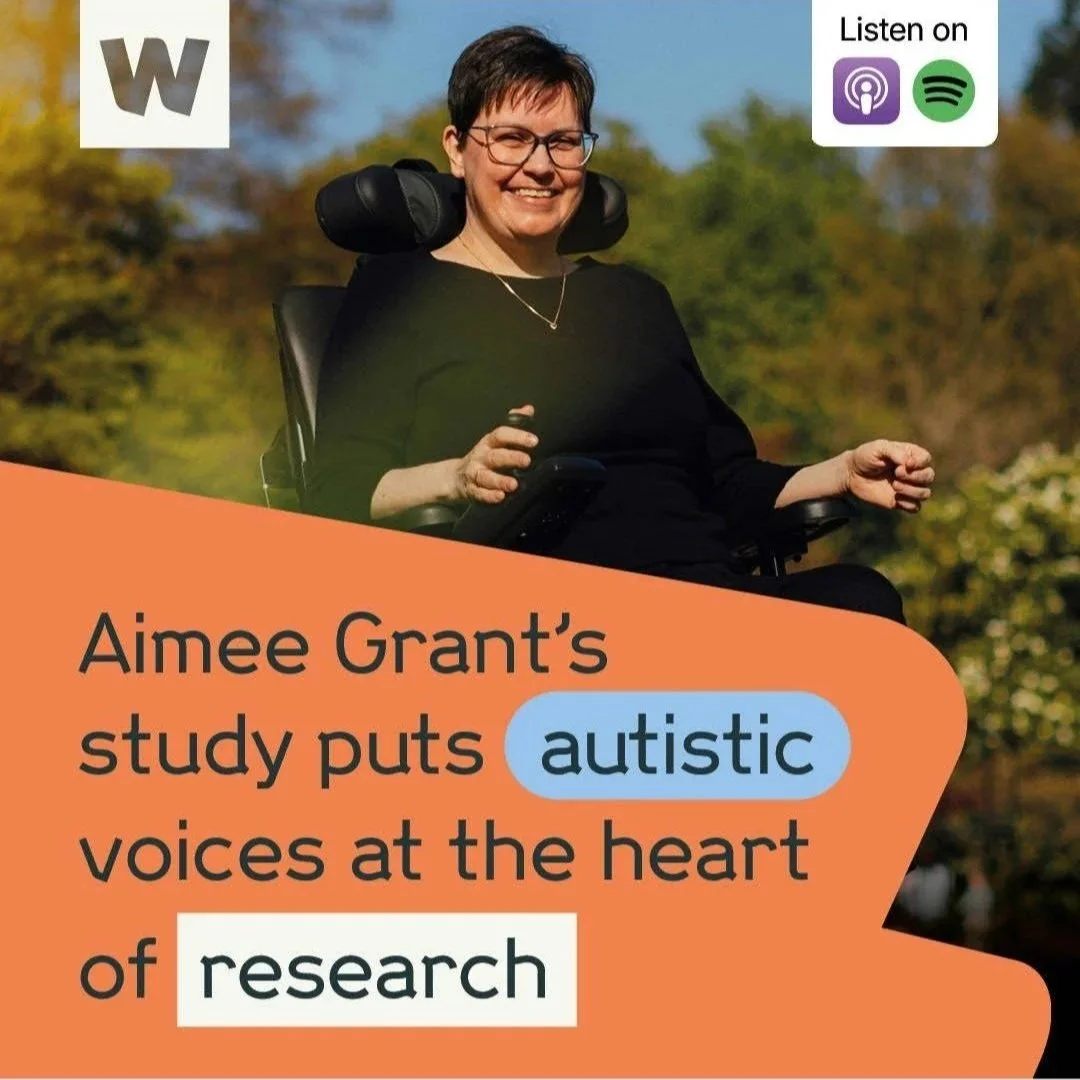
When Science Finds a Way. Inclusive Research: Autism from Menstruation to Menopause
Navigating healthcare can be particularly challenging for autistic people. Reasons for this are complex, but for women and people assigned female at birth, the problem is compounded by a lack of representation in autism research, leaving healthcare services ill-equipped to meet their specific needs.
Alisha speaks with Dr Aimee Grant about a groundbreaking study that’s working to change this. Led and delivered entirely by autistic people, Autism: from Menstruation to Menopause is gathering data across the reproductive life cycle to design tools that make healthcare more accessible and inclusive. We also meet three members of the project’s Community Council, who are co-designing the research and sharing what it means to work with a fully neurodivergent team. Together, they’re proving that inclusive research isn’t just better, it’s essential.
Exploring Global Problems. Season 3, Episode 8
Autistic people have worse physical and mental health than their allistic (non-Autistic) peers. This includes dying between 16 and 30 years early. Deficit narratives of Autism, discrimination towards Autistic people and significant healthcare inaccessibility all contribute to this.
In this episode, Dr Aimee Grant discusses how their research looks to uncover Autistic people’s lived experiences and healthcare needs to reduce and reverse health inequalities.
The Second Shift. Autism and Motherhood. 1st May 2022
Karen chats with researcher Dr Aimee Grant who has recently been looking into the experiences that autistic mothers have of feeding their babies, and then goes on to talk to antenatal teacher and autistic mother Ruth Jenks, who volunteers for the organisation Autistic Parents UK.

Autism Stories. Dr Aimee Grant. 3rd January 2022
"Although it's a biological function, it's not something straight forward. It's not that you just hover the baby somewhere near the breast and it works. There's a complex range of positioning, attachment, the baby's suck needs to be right. Often, babies are born with an extra little piece of skin under their tongue. That means that their tongue can't move enough to actually help release milk," says Dr. Aimee Grant. Aimee joins us to discuss her research on breastfeeding, executive functioning and sensory challenges in breastfeeding, and the advantages autistic researchers have. when they do qualitative research.
The Second Shift. Out and About with your baby. 1st December 2021
“Out and About With Your Baby is an episode about exactly that: Breastfeeding in Public. This is another episode prompted by Amy Brown (I’m noticing a theme here) recommending that I speak to her research colleague Aimee Grant, with whom I had a lovely conversation. I honestly didn’t think I had much to learn about this, as a breastfeeding mother for over three years and a breastfeeding counsellor for over a decade. Of course I was wrong.” - Karen Hall.